
If you had to pick the fastest and most successful way to send your GP into orbit it would be to start any sentence with: “Chat GPT [1]has told me my symptoms mean I have [xyz]” followed by: “So, can you prescribe me [abc]”
In fact, let’s not single out GPs, as this could apply to any profession that operates using the magic triad of identifying symptoms, diagnosing the cause and recommending solutions, including internal communications. In my corporate days, I used to call the GP scenario the “I want a nose job” approach because my executive would be very specific about the solution they wanted, but vague about the problem. I’m not suggesting that people never show up to plastic surgeons and provide an open brief by asking: “How can you improve me?” But in my limited experience of friends who have had procedures, they seemed to have a laser-like focus on what they wanted enlarged or reduced.
And because there’s never a situation where a four-box grid isn’t relevant, this is how this generally applies in internal communications, where the x-axis maps the specificity of the outcome and the y-axis indicates how much opportunity you have to define the problem.
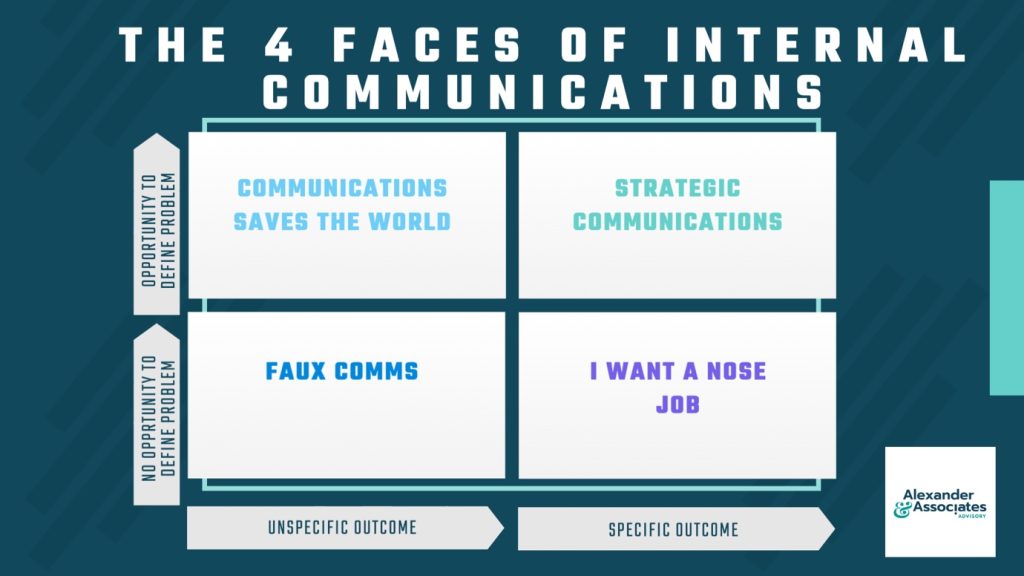
I want a nose job – specific outcome/no opportunity to define the problem
You will already have been asked to perform more nose jobs than you’ve had hot dinners by the time you’ve clocked your first anniversary working in internal communications. It will look something like this:
Executive: “Jo, we need a video. Can you organise that for me?”
You: Yes, of course, but can I just ask why you think you need a video?
Executive: We need to get with the cool kids. My 15-year-old kid reckons video is the only way to communicate now. They’re all everybody watches on TikTok/Instagram/Facebook these days.
You: Sure. Would you mind outlining the problem you’re hoping this video will address?
Executive: Well, we need to engage our people. They’re massively unengaged.
Righto, one video coming up
Faux Comms – unspecific outcome/no opportunity to define the problem
You’ve hit rock bottom when you didn’t have any opportunity to scope out the problem, and you skipped the bit where you identify what you’re trying to achieve. In this scenario, you’re just thrashing around in the paddling pool, creating a lot of noise and distraction.
Communications Saves the World – unspecific outcome/opportunity to define the problem
Although technically an improvement on a nose job, as you get to be involved in defining the problem, it still leaves you stranded without GPS or a map, as you haven’t determined the objectives of your project and won’t know if your work has been successful. The upside is you can call victory at any moment and pretend you’re the heroes, but it’s a bit of a hollow triumph. This approach tends to conflate activity with an outcome, and anyone who has tried to make a pavlova knows that just because you whisked the egg whites, it doesn’t necessarily guarantee a sticky, crunchy, meringue masterpiece.
Strategic Communications – specific outcome/opportunity to define the problem
That Nirvana spot in the top right-hand corner of the grid. This is where you researched and defined the underlying problem and scoped out some practical objectives that you could measure. Maybe your nose was just dandy and all you needed was a good facial.
NOTE: There is a distinct possibility that Chat GPT will replace all of us, including GPs. However, I’m banking that some professions will hang on longer, insulated by the life-preserving qualities of a huge back catalogue of crystallised intelligence gained from life experience, and not available on the internet.